

Introduction
One of the fundamental insights of the Cosmic Influx Theory (CIT) is that the structure of planetary systems is not random but follows a predictable pattern based on the Root Mean Square Velocity (VRMS) of the original protoplanetary disk.
This chapter explores:
- The definition and significance of VRMS in planetary dynamics.
- How VRMS determines the Preferred Distance (Dpref) [8.2.8].
- The role of the Universal Scaling Constant (κCIT).
- The link between VRMS and observed exoplanetary systems.
2.1 How VRMS is Related to Cosmic Structuring
The Root Mean Square Velocity (VRMS) is a statistical measure of velocities within a system. In CIT:
- The original protoplanetary disk had a characteristic VRMS.
- This velocity defines a Preferred Distance at which mass concentration tends to occur.
- The largest planets are often found near this distance.
The equation for the Preferred Distance is:
 ……..(2.1.1)
For planets around stars, the Preferred Distance relation can also be written in the familiar orbital form:
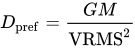
This is the same as the well known Newtonian expression for orbiting planets:

D is replaced by the Preferred Distance Dpref, and the velocity is replaced by the VRMS.
since in CIT:
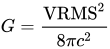
Combining this with the Preferred Distance relation gives:
Definition of κCIT
CIT introduces a fundamental proportionality constant:
 ……..(2.1.2)
This can also be expressed as:
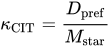 ……..(2.1.3)
or:
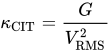 ……..(2.1.4)
- Note: This expression arises from relativistic energy formulations and carries units of m/kg when derived from dimensional analysis of G and VRMS.*
The precise calculated value is:
κCIT=4.427093908810190×10⁻¹⁹ m/kg
This remarkable connection suggests that:
- Planetary structuring is governed by fundamental constants, linking gravitational mass distributions with the speed of light.
- The Preferred Distance is an intrinsic property of cosmic structuring, rooted in mechanics and electrodynamics.
- The scaling factor 18πc2
 unites gravitational and electromagnetic principles, reinforcing the internal consistency of CIT.
These equations accurately predict the location of giant exoplanets in other star systems, reinforcing CIT’s predictive value.
2.2 The Connection Between CIT and General Relativity
CIT does not reject General Relativity, but offers a complementary perspective, proposing that gravitational effects arise from a continuous influx of energy — an external flow into matter that contributes to its mass-energy and gravitational influence.
This leads to three key extensions of traditional gravitational theory:
- The gravitational field is not just a curvature of spacetime, but the observable result of an influx of energy. This influx guides objects along curved paths, producing the effects attributed to spacetime curvature in General Relativity.
- The gravitational acceleration (g or a) at a planet’s surface depends on the intensity of the energy influx, which is related to the total mass of the object.
- Observed planetary distances are not random, but reflect a cosmic structuring principle derived from the Root Mean Square Velocity (VRMS) and the resulting Preferred Distance (Dpref).
A resonant-field curvature formulation that leads to the same effective coupling as the mechanical influx picture used in CIT is presented in Panagis & Loeffen (2025) [8.4.48].
2.3 The Preferred Distance (Dpref) and Its Calculation
CIT introduces the concept of the Preferred Distance (Dpref), the location where the most massive planets tend to form.
……..(2.3.1)
where:
- κCIT
 is the Universal Scaling Constant for Planetary Structuring, approximately 4.4271×10⁻¹⁹ m/kg
 .
. - Mstar
 is the mass of the central star.
This proportionality helps explain:
- Why Jupiter and Saturn formed at their observed distances in our solar system.
- Why exoplanets tend to cluster at specific radii from their stars.
- Why ring and gap structures in protoplanetary disks exhibit ordered patterns [8.3.2].
2.4 Empirical Confirmation from Exoplanetary Systems
The predictions of CIT align closely with observed exoplanetary systems:
- The distribution of exoplanets shows clustering of dust and gas at specific distances.
- Protoplanetary disks exhibit gaps that correspond with predicted values of Dpref.
- The TRAPPIST system may potentially host a yet-undiscovered giant planet near Dpref=7.825×10¹⁰ m
 .
.
Future observations from the James Webb Space Telescope (JWST) may provide additional confirmation.
Observational Challenges at the Preferred Distance (Dpref) Detecting giant planets at the Preferred Distance predicted by CIT is a significant observational challenge. These planets typically have long orbital periods — often spanning many years or even decades — meaning they may not have completed a full orbit since their host systems were first monitored. Furthermore, it may take equally long for such a planet to transit again, delaying confirmation.
Detection also depends on alignment: for radial velocity or transit methods to succeed, the planet must pass in front of the star from Earth’s point of view. In addition, the central star must be sufficiently massive to generate a detectable planetary body at Dpref.
A promising alternative is to focus on protoplanetary disks. In these early-stage systems, concentric rings and gaps may indicate emerging planets. CIT suggests that the Preferred Distance corresponds to a balance point between the inward-directed influx stream and the orbital motion of the disk’s material — making this region a prime location for early planet formation. Observing such structures can provide indirect evidence supporting CIT’s planetary structuring model.
2.5 Implications for Planetary Formation Models
The connection between VRMS and planetary structuring suggests that:
- Planetary migration models may need to include VRMS-based structuring principles.
- The gravitational constant (G) may reflect deeper connections with kinetic and relativistic parameters.
- Galactic structure formation might follow similar VRMS-based ordering on larger scales.
Recent observational evidence supports CIT predictions
A study published in the Publications of the Astronomical Society of Japan presents super-resolution imaging of 78 protoplanetary disks in the Ophiuchus star-forming region: ALMA 2D super-resolution imaging survey of Ophiuchus Class I/flat spectrum/II disks. I. Discovery of new disk substructures (Shoshi et al., 2025).
This study reveals that ring and spiral substructures already emerge a few hundred thousand years after star birth—much earlier than expected in traditional models. These findings significantly increase the statistical sample size over earlier ALMA projects (DSHARP and eDisk) and provide strong evidence for patterned disk evolution very early in stellar formation.
A ChatGPT-assisted review of this publication concludes:
“Relevance to Cosmic Influx Theory (CIT): This article supports CIT indirectly. CIT emphasizes structured, early planetary formation within dynamic disk environments. The observed early appearance of ring-like substructures aligns with CIT’s prediction that large planets form in dominant rings at Preferred Distances (Dₚᵣₑf) shortly after star formation. The rapid onset of such structuring offers observational backing to CIT’s premise of early, patterned planetary genesis—before classical accretion or migration theories would expect such development.” (See full analysis: ChatGPT Share Link)
These observations reinforce the view that the cosmic influx does not act only over long timescales, but plays a formative role from the earliest phases of stellar and planetary development.
A disk is the primary environment; collisions are then a secondary consequence of that environment. That ordering matters. If one starts from collisions, one risks treating violent impact as the default creative mechanism. But if one starts from disks, then collisions become only one of several natural processes inside an already existing, evolving orbital system.
That is also the more physically economical picture:
A disk already contains the ingredients for growth, sorting, resonance, fragmentation, accretion, migration, and occasional impacts.
So one does not need a catastrophic collision as the first explanatory step.
One first asks how matter organizes in the disk, and only then whether some observed debris requires a major impact.
In that sense, Saturn’s rings are a good intuitive example. They show that orbiting systems are not static: particles collide, merge, scatter, fragment, and reorganize continuously. But nobody would say the rings are fundamentally “about catastrophe.” They are fundamentally about a disk-like orbital structure with ongoing internal interactions.
CIT can fully admit that collisions occur, including severe ones, while still maintaining that the broader formation of planets and moons is rooted in protoplanetary and circumplanetary disk dynamics. In that framing, catastrophic collisions are real but not foundational. They are episodes within the larger whirling history of disk evolution.
This opens the possibility of extending CIT from planetary systems to broader cosmic evolution.
Extension to circumplanetary disks and moon formation
The Preferred Distance concept may also have implications beyond planetary formation around stars. If Dpref expresses a general structuring tendency in rotating matter systems, then a similar principle may also be expected in circumplanetary disks around forming planets. In that case, the same relation
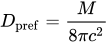
with M representing the mass of the planet, can define a local preferred formation zone for moons. This suggests that moon systems may represent a smaller-scale repetition of the larger protoplanetary process.
For planets around stars, the Preferred Distance relation can also be written in the familiar orbital form:
since in CIT:
Applying the same logic to moons orbiting planets gives:
where D is the actual orbital distance of the moon and vp
 its measured orbital velocity around the planet. Combining this with the Preferred Distance relation gives:
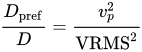
and thus:
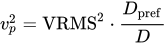
or equivalently:
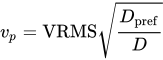
These equations show that the orbital velocity of a moon can be interpreted as a local circumplanetary expression of the more general CIT structuring principle. In this view, VRMS is not the direct orbital velocity of the moon itself, but the reference velocity scale from which the local moon velocity follows through the ratio between the Preferred Distance and the actual orbital distance.
At the same time, present orbital distances of moons should not automatically be expected to match the local Preferred Distance exactly. Circumplanetary disks consist of a complex mixture of dust, grains, gas, ions, and growing clumps, in which aggregation, fragmentation, thermal exchange, chemical differentiation, ionisation, turbulence, and resonance effects all influence the final structure. Within the CIT framework, these processes may occur while matter also continues to absorb mass-energy from the PEW background. As a result, moons may originate near a preferred zone but later shift through migration, tidal evolution, capture, or long-term dynamical adjustment.
This broader interpretation suggests that Preferred Distance should be understood as a large-scale organizing principle rather than as a strict final orbital rule. Planets in a protoplanetary disk and moons in a circumplanetary disk may both arise within structured rings or whirls, while their present positions reflect the combined outcome of original structuring and later evolution. In this way, CIT proposes a hierarchical model of cosmic formation in which similar ordering principles may operate from star systems down to moon systems.
2.6 Measuring the VRMS
A useful interactive tool for exploring the concept of the root-mean-square velocity (VRMS) in relation to the Cosmic Influx Theory (CIT) is provided by Gabino Casanova through his open-source visualisation project: https://gabinoc67.github.io/interstellar-star-clock/demos/vrms.html
Overview of the tool
The web-based simulator, titled CST-Locked v-RMS Gravity Equivalence – VT ≡ CIT, enables users to explore the relationship between the VRMS velocity scale and the estimated gravitational constant. It c2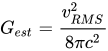
where c is the speed of light and vRMS
 is the user-adjusted velocity parameter.
The interface includes:
- Planetary presets (Earth, Sun, Mercury, etc.)
- An Auto-Scan routine that compares Gest
 to the standard terrestrial constant G0=6.67430×10⁻¹¹ m3kg−1s−2
- Fine-tuning sliders for density, noise, and influx/vibration blending
- A visual feedback mode showing whether the computed Gest passes or fails the target precision.
The tool is accessible here: Gabino Casanova – VRMS Demo
Relevance to Cosmic Influx Theory
- The simulator links directly to the CIT postulate that gravitational behaviour emerges from a universal velocity scale, expressed as the VRMS ≈ 12 278 m/s.
- By setting the simulator to match Gest=G0
 , users can empirically test which VRMS values reproduce the gravitational constant predicted by CIT:

- The Auto-Calibrate function provides an intuitive way to visualise how different VRMS settings influence the computed gravitational constant, supporting CIT’s claim of a kinetic relationship between the influx field and gravitational strength.
- The tool’s planetary presets also allow testing how CIT’s universal VRMS could manifest across planetary systems of varying mass and density.
Observational and critical notes
Although the simulator provides an excellent educational interface, it is primarily a conceptual visualizer rather than a precise experimental instrument. Key considerations:
- The author labels it as a “concept visualizer; substitute observed modes when available”, reminding users that the displayed data are for illustration.
- The mapping Gest=vRMS2/(8πc2)
 should be interpreted in CIT as a simplified expression of the proportionality between influx velocity and gravitational coupling.
 - Adjustable factors such as “noise mix” or “influx/vibration blending” are useful for sensitivity studies but require clear physical interpretation within CIT’s framework of the Primordial Elementary Whirlings (PEWs) that transfer energy through the influx.
- When using planetary presets, readers should remember that CIT’s VRMS refers to the early protoplanetary disk conditions, not the present orbital velocities of planets.
Integration into the CIT workflow
Within this chapter, the website may serve as a visual bridge between the theoretical and observable realms of VRMS. Readers are encouraged to:
- Use the tool to verify that a VRMS around 12.3 km/s yields a Gest value close to the accepted constant.
- Observe the live deviation Δ vs G₀ % shown by the simulator.
- Compare the results with CIT’s derived equations for gravitational coupling and energy influx.
A screenshot or embedded link to this page may be included to illustrate this relationship in action.
Reference
- Gabino Casanova (2025). CST-Locked v-RMS Gravity Equivalence – VT ≡ CIT. https://gabinoc67.github.io/interstellar-star-clock/demos/vrms.html
- Loeffen, R. (2025). Cosmic Influx Theory – Chapter 2: Lorentz Transformation and Mass-Energy Relations. Wikiversity.
Summary
This chapter introduced:
- The concept of VRMS and its role in planetary dynamics.
- The equation for the Preferred Distance (Dpref) and the derivation of the Universal Scaling Constant.
- How CIT aligns with observed data from exoplanetary systems.
- Implications for planetary formation and gravitational theory.
In the next chapter, we will explore how the Cosmic Influx relates to the gravitational constant (G).
++ Navigation