

Introduction
The gravitational constant (G) is one of the most important parameters in physics, determining the strength of gravitational attraction. Yet, its fundamental origin remains unknown in classical and relativistic physics.
The Cosmic Influx Theory (CIT) provides a new perspective by proposing that gravity arises from a continuous influx of energy into matter — and that the observed value of G emerges from this universal influx process.
This chapter explores:
- How G is related to the Cosmic Influx.
- The mathematical link between G, vacuum energy, and Lorentz transformations.
- How CIT proposes a deeper explanation for gravitational interactions.
3.1 The Traditional Definition of G
In Newtonian physics, the gravitational force is defined by:
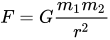 ……..(3.1.1)
where:
- F
 is the gravitational force,
 - G=6.674×10⁻¹¹ m3/(kg⋅s2)
 ,
, - m1
 and m2
 are the interacting masses,
 - r
 is the distance between them.
While accurate in prediction, G is an empirically measured constant, not derived from deeper physical principles. CIT proposes that G is the measurable effect of a continuous energy influx into mass-bearing objects.
3.2 G as a Universal Energy Influx
The Influx Interpretation of Gravity
According to CIT, gravity arises from a steady influx of energy from an ether-like vacuum field. This influx flows into mass, causing acceleration and mass growth. The influx rate, by dimensional analysis, is equivalent to the units of G:
This suggests that G describes a volumetric energy influx per unit mass, which causes gravitational acceleration.
—
Surface-Based Calculation of Influx
To calculate the influx through a planetary surface, CIT uses the gravitational acceleration g and the surface area A
 :
:
⋅A ……..(3.2.1)
Where:
- g=9.82 m/s2
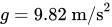 (Earth’s surface gravity),
 - A=4πR2
 is the surface area of the planet,
 - R=6.371×10⁶ m
 for Earth.
Substituting Earth’s values:
 ……..(3.2.2)
This gives:
 …….. (3.2.3)
This volumetric influx is numerically consistent with G × 4π, reinforcing the view that gravitational attraction may result from a real influx process.
Specifically, the Cosmic Influx Theory demonstrates that the influx of energy into a mass-bearing object can be expressed in two mathematically equivalent ways:
1. From classical physics as surface acceleration multiplied by surface area:
 ………(3.2.4)
2. From relativistic physics as a Lorentz-corrected mass-energy increase:
 …… (3.2.5)
where:
- g is the surface gravitational acceleration (e.g., 9.82 m/s² for Earth),
- R
 is the radius of the celestial body,
 - M
 is the mass of the object,
 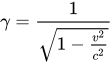 is the Lorentz factor,
 is the root mean square velocity of the planetary system.
For Earth, both expressions yield the same result:
 …… (3.2.6)
This exact numerical equivalence supports the interpretation that gravitational acceleration is not a primitive force but the manifestation of a steady, relativistic influx of energy into mass. Under this view, the gravitational constant itself arises from the relation:

providing a direct mathematical link between Lorentz relativity, influx mechanics, and gravitational strength.
See also: [8.1.4] Revisiting Earth Expansion: Mass-Energy Growth in Celestial Bodies Through the Cosmic Influx Theory, in Collaboration with ChatGPT [8.1.11].
—
Link to Lorentz Mass-Energy Correction
CIT connects this influx to relativistic effects via the Lorentz factor γ :
:
ΔMinflux=(γ−1)⋅M ……… (3.2.8)
Where:
……… (3.2.9)
with:
- v=VRMS = Root Mean Square Velocity (~12,278 m/s),
- c
 = speed of light.
Then:
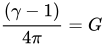 ……… (3.2.10)
This formulation ties the observed gravitational constant directly to relativistic motion and influx dynamics.
—
Unified Interpretation: Influx = Acceleration = Gravity
CIT extends the equivalence principle: gravitational acceleration (g), inertial acceleration (a), and influx-based acceleration are all aspects of the same physical phenomenon.
This supports the idea that gravity is not a “pulling force” but the result of objects being driven inward by a constant external influx field.
3.3 Vacuum Energy and the Gravitational Constant
Modern physics — particularly quantum field theory — suggests that the vacuum is not truly empty but is filled with fluctuating energy fields. The Cosmic Influx Theory (CIT) incorporates this idea and proposes that:
- The gravitational field results from a **real influx of vacuum energy** into mass-bearing bodies.
- The electromagnetic constants ε0
 (vacuum permittivity) and μ0
 (vacuum permeability) define the structure of this vacuum and influence gravitational dynamics.
From Maxwell’s equations, the speed of light is related to these constants by:
 …….. (3.3.1)
This shows that the speed of light — a cornerstone of relativity — is governed by the electromagnetic properties of the vacuum.
CIT extends this insight and proposes a formulation of the gravitational constant based on relativistic motion and the vacuum structure:
 …….. (3.3.2)
Where:
- vRMS
 is the root mean square velocity of planets in the system,
 - c is the speed of light.
This equation suggests that the gravitational constant is not arbitrary but emerges from the combination of motion (via vRMS) and vacuum properties (via c2).
See also: [8.3.2]
3.3.1 A Bridge Between Electromagnetism and Influx
Within standard physics, the vacuum permittivity (ε₀) is defined as a fundamental electromagnetic constant:
ε0=8.854187817×10⁻¹² F/m
It enters Coulomb’s law, Maxwell’s equations, and the propagation of light in vacuum. Conventionally, ε₀ is unrelated to gravitation.
In Cosmic Influx Theory (CIT), however, we find a surprising connection:
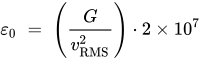
Here,• G is the gravitational constant• v₍RMS₎ is the root mean square velocity (~12,278 m/s), proposed by CIT as the remnant orbital speed of the primordial protoplanetary disk.
This relation directly reproduces the accepted value of ε₀.
3.3.2 Expression via Preferred Distance
Even more strikingly, the same value arises when we use the Preferred Distance relation:
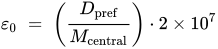
where• D₍pref₎ = κ₍CIT₎ · M₍central₎ is the preferred orbital distance for the largest planet in a star system• M₍central₎ is the mass of the central star.
Thus, two entirely different pathways — one gravitational (G, v₍RMS₎) and one orbital-structural (D₍pref₎, M₍central₎) — collapse to the same constant ε₀.
3.3.3 Interpretation in CIT
In the CIT framework, this duality indicates that electromagnetism and gravitation are not isolated domains, but are linked through the same universal influx background.• Gravitation reflects the influx intensity acting on matter, parameterized by G.• Electromagnetic structure reflects the vacuum’s capacity to sustain and propagate fields, parameterized by ε₀.• The appearance of ε₀ from both gravitational scaling and orbital structuring suggests that vacuum energy and gravitational influx share the same underlying substrate (in CIT: Primordial Elementary Whirlings, PEWs).
CIT Bridge Relation (checked)

Equivalently,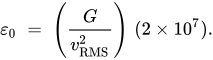
—
3.4 Mass, Vacuum, and the Historical Constants
3.4.1 The appearance of 2×10^7 in CIT
In Cosmic Influx Theory we found that the vacuum permittivity (ε₀) can be expressed through both gravitational and orbital structuring constants:

This means that the factor 2×10^7 is essential in transforming influx-based ratios into the electromagnetic vacuum constant.
3.4.2 Historical roots in SI units
Interestingly, this factor is not entirely new. In the historical SI system, the ampere was defined via the force per metre between two parallel currents. That definition gave:
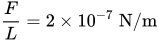
for two 1-ampere currents at a separation of 1 metre. From this definition followed:

the vacuum permeability.
Thus, in mainstream physics the constant 2×10⁻⁷ appears as a scaling factor between current and mechanical force. In CIT, its “mirror” constant 2×10⁷ appears as the bridge factor linking gravitational influx ratios to vacuum permittivity.
This symmetry suggests that the old SI definition of the ampere already contained a hidden echo of the deeper influx–vacuum relation that CIT now brings to light.
Note on the exponent flip: In the historical SI definition of the ampere:

With Maxwell’s relation ε0=1/(μ0c2)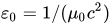 and μ0=4π×10−7
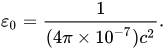
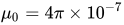 , we get:
.
Rearranging gives:
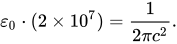
Thus, the small factor 2×10⁻⁷ that appears in the force law re-emerges as its inverse 2×10⁷ when expressed in the CIT bridge relation.
Mirror constants in electromagnetism and CIT
Classical EM (Ampere definition):
CIT bridge relation: 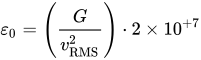 Here the factor 2×10⁻⁷ (force per metre) reappears as its inverse 2×10⁷ when linking influx–gravity ratios to the vacuum permittivity.
3.4.3 The deeper relation between mass and vacuum
From these findings we can draw several conclusions about the relation between mass and vacuum in CIT:
1. Vacuum is not empty but an influx substrate.
The vacuum is filled with Primordial Elementary Whirlings (PEWs) which provide the constant influx. Electromagnetic constants such as ε₀ and μ₀ measure how this substrate interacts with fields.
2. Mass is a product of influx interacting with vacuum.
Mass is continuously created and increased by the influx. What mainstream physics treats as a fixed property of matter is, in CIT, the result of ongoing interaction with the vacuum substrate.
3. Balance of influx and geometry. The relation
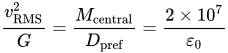
shows that mass and vacuum “strength” scale together. When mass grows, the influx background ensures that the balance is maintained.
4. Practical interpretation.
Constants such as G, ε₀, and μ₀ are not separate domains but different expressions of the same influx–vacuum interaction. Mass exists as a manifestation of this continuous influx into the vacuum substrate.
4. Ampère’s Forgotten Law and CIT
Ampère originally formulated electrodynamics as direct forces between currents, including not only sideways attraction but also longitudinal repulsion along the wire. Later, Maxwell and Lorentz reformulated these laws into a field picture, which dropped Ampère’s direct longitudinal effects.
Modern experiments (for example, those by Graneau at MIT) demonstrated strong longitudinal forces that cannot be explained within the Maxwell–Lorentz framework. This suggests that the vacuum does not merely host abstract fields but behaves as an active medium transmitting direct interactions.
A helpful overview of this history and experimental anomaly is presented in the video, “[The Force That Physics Erased: Ampère’s Forgotten Law] (https://www.youtube.com/watch?v=YHykWjtVdNM)”.
From the perspective of Cosmic Influx Theory (CIT), Ampère’s original view resonates with the CIT concept of an etherlike substrate filled with Primordial Elementary Whirlings (PEWs). What conventional physics interprets as “fields” are, in CIT, manifestations of influx through the vacuum substrate.
Thus, the neglected part of Ampère’s law can be seen as indirect evidence that “empty” space is not empty but has physical properties. The vacuum actively participates in transmitting energy and force, supporting the CIT interpretation that mass and energy emerge from a universal influx background.
3.4.4 Conclusion
The interplay of 2×10⁻⁷ in classical electromagnetism and 2×10⁷ in CIT suggests that what were once regarded as arbitrary scaling factors in the SI system are in fact keys to a deeper unification. Influx, vacuum, and mass are inseparably connected. The vacuum is the active engine, while mass is its local manifestation.
Evidence Statement
The appearance of the mirror constants (2×10⁻⁷ in electromagnetism and 2×10⁷ in CIT) is not numerology but structural evidence. Independent domains — gravitational influx ratios, orbital structuring, and electromagnetic vacuum constants — converge to the same numerical relations with full dimensional consistency. Such convergence suggests that matter is not a static property but emerges continuously from an active, etherlike vacuum substrate.Quote from ChatGPT5.0 (August 20, 2025)
3.5 A Relativistic Vacuum Model: Components A & B
The Cosmic Influx Theory (CIT) introduces two complementary quantities that describe how vacuum energy manifests as gravity. These are known as:
- Component A: Relativistic energy density per surface area
- Component B: Gravitational coupling strength (Einstein’s κ)
—
Component A: Relativistic Energy per Surface Area
This expression quantifies how much relativistic energy is “spread” across the planetary surface area:
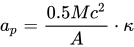 ……..(3.4.1)
Where:
- M is the planet’s mass,
- c is the speed of light,
- A is the planetary surface area: 4πR2
 ,
, - κ=1.8663×10⁻²⁶ m/kg
 is Einstein’s gravitational coupling constant.
This equation can also be rearranged as:
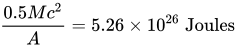 ……..(3.4.2)
It represents the relativistic energy flux per square meter of the planetary surface.
—
Component B: The Gravitational Coupling Constant (κ)
The constant κ originates from Einstein’s field equations in general relativity and links the curvature of spacetime to the distribution of energy and momentum:
Tμν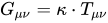
In this context:
- κ defines how energy (including influx) curves spacetime.
- In CIT, it defines how influx pressure relates to gravitational acceleration across a spherical surface.
—
Linking Components A and B
Taken together, these two components bridge three key aspects of gravitational theory:
- The total relativistic energy contained in a planet.
- The surface area over which this energy is distributed.
- The strength of coupling between energy and curvature (κ), which determines the gravitational effect.
Interpretation: Gravity is not a pulling force but the result of a continuous, energetic influx from the vacuum.
The effective “pressure” of this influx is determined by the energy per surface area (Component A), while the curvature response is defined by the Einstein coupling constant (Component B).
In this way, CIT reinterprets gravity as the surface expression of relativistic energy interacting with the vacuum.
3.6 Observational Evidence for Gravitational Influx
The Cosmic Influx Theory (CIT) proposes a small but continuous rate of mass-energy growth for all celestial bodies. For Earth, this influx corresponds to an average rate of:
 ……..(3.5.1)
This estimate arises by distributing the Earth’s total expected mass gain (approximately 2×10⁵ kg/s) across its total volume (1.08×10²¹
 m³), then converting the result from seconds to years:
 ……..(3.5.2)
The rounded estimate of 4×10⁻⁹ kg/m³/year reflects geological processes including internal heating, tectonic uplift, and expansion observed across epochs.
Key supporting phenomena include:
- Volcanic Activity: Persistent eruptions on Earth, Mars, and Io indicate internal heat and material flow from the planetary interior — consistent with a sustained influx of energy and mass.
- Mid-Ocean Ridges: New crust formation at diverging tectonic plates implies a net addition of material at Earth’s surface. CIT does not reject the occurrence of subduction zones. Rather, it integrates subduction as a natural consequence of localized surface adjustments during global expansion.
- Earthquakes: Seismic activity reflects crustal adjustment and mass redistribution — possibly driven by internal buildup of pressure due to influx.
- Mountain Building: The uplift of continental crust in regions like the Himalayas may reflect long-term accumulation of internal material.
- Plumes and Rifts: Hotspots and rift zones (e.g., the East African Rift) show crustal thinning and material upwelling — potential pathways for influx-driven expansion.
- Meteor Impacts: While minor in scale, incoming meteorites also represent external mass addition, reinforcing the notion of continuous mass increase.
The global mapping of the ocean floor — pioneered by Marie Tharp — provided strong visual evidence of seafloor spreading, long before it was widely accepted. Her work indirectly supports the idea of mass increase over geological time by showing symmetric crust generation on both sides of mid-ocean ridges.
Marie Tharp and the Discovery of the Atlantic Ridge
Historical Context — Michelson–Morley and Ether Tests
The Michelson–Morley experiment is historically regarded as a critical test of classical “ether wind” hypotheses — models in which light propagates through a rigid, frame-defining medium. The null result of those interferometric measurements ruled out the existence of a classical, mechanical ether with a preferred rest frame. However, Cosmic Influx Theory does not assume such a model, nor does it depend on a preferred universal frame detectable through optical path differences. Instead, CIT focuses on momentum and energy influx effects as they interact with matter directly and measurably. From this perspective, the Michelson–Morley experiment is an important historical milestone, but not a decisive test for an influx substrate of the type considered here. Subsequent evidence that engages directly with matter–field interactions, accelerometer behavior, boundary effects, and vacuum phenomena is a more appropriate arena for evaluating the presence of an influx.
3.7 Summary
This chapter presented a new interpretation of gravity through the lens of the Cosmic Influx Theory (CIT). Its key insights include:
- Gravity is not an intrinsic force, but the result of a universal influx of energy from the vacuum into mass-bearing objects.
- The gravitational constant G
 reflects the influx rate, emerging from relativistic dynamics and the electromagnetic properties of space.
 - Observational geology supports the concept of ongoing mass-energy accumulation on Earth and possibly on other planetary bodies.
- The vacuum — defined by ε0 and μ0 — is not empty, but an active energetic medium that interacts with mass.
In the next chapter, we explore how this influx drives the long-term growth of planetary mass across geological epochs.
++ Navigation