

Introduction
The Cosmic Influx Theory (CIT) suggests that celestial bodies do not remain static but gain mass-energy over time due to an external influx. This process is not only responsible for planetary growth but may also play a role in the cosmic expansion of the universe.
This chapter explores:
- How CIT explains planetary growth through mass-energy influx.
- The connection between cosmic expansion and the energy influx.
- Geophysical evidence from Earth’s tectonic activity.
- How these principles apply to stars and galaxies.
5.1 Planetary Growth Through Mass-Energy Influx
Traditional planetary science assumes that planets formed early in the Solar System’s history and have remained the same size. However, CIT suggests that:
- Planets continue to grow by absorbing external energy.
- This process happens over geological timescales [8.3.6] .
- The mass increase follows a predictable rate based on the influx.
A key relation in CIT is:
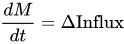 …….. (5.1.1)
where:
 is the rate of mass increase over time.
 represents the volumetric universal influx contributing to mass-energy growth.
This process explains:
- The Earth’s expanding ocean floors.
- Planetary differentiation and core heating.
- Volcanism and tectonic activity.
5.2 The Link Between Cosmic Expansion, Hubble Acceleration and CIT
In modern cosmology, the expansion of the universe is attributed to a mysterious force called dark energy. The Cosmic Influx Theory (CIT) offers an alternative or complementary explanation:
The universe expands because mass-energy influx affects the very structure of spacetime. Galaxies and clusters are not only moving apart—they are continuously gaining mass-energy, leading to structural transformations at every scale. This suggests that cosmic expansion is not merely a matter of recession velocity, but also a consequence of growing mass, expanding orbital paths, and increasing distances.
In the CIT framework, the Hubble acceleration can be seen as the result of:
The increasing mass-energy of celestial objects,
Accompanying increases in orbital velocities and trajectories,
Widening distances between massive bodies,
And an expanding spacetime geometry shaped by accumulated influx.
This suggests that the Hubble constant (H₀) may not be a simple function of velocity or distance, but also a reflection of mass increase over cosmic time. As galaxies accumulate mass, the way we interpret redshift, distance, and cosmic age must be reconsidered.
5.2.1 Growing Galaxies and Cosmic Redshift
In standard cosmology, the Hubble constant describes the rate at which galaxies recede due to spacetime expansion. However, in Cosmic Influx Theory (CIT), part of the observed redshift may result from the gradual accumulation of mass-energy within galaxies, altering the way they emit and interact with light over time.
In this view, space does not expand independently. Instead, expansion is a byproduct of increasing mass-energy reshaping the geometry of space.
This is in addition to standard cosmology, where expansion is driven by “dark energy”. In CIT, dark energy could be interpreted as a universal ether-like energy field — the foundational substrate from which mass-energy influx originates
5.2.2 Growing Planets Born in Protoplanetary Disks
CIT proposes that planets are not formed in a fixed state but instead emerge and grow over time within protoplanetary disks. These disks, composed of gas and dust, are observed to form multiple ring structures around young stars, as seen in systems like HL Tauri, HD 163296, and GW Orionis.
Within CIT, the Preferred Distance (D_pref)—determined by the Universal Scaling Constant κ_CIT—marks the location where the most massive planets tend to form. At these distances, the mass-energy influx is most effectively converted into gravitational structuring, allowing a dominant planet to grow over time.
This process implies a continuous accumulation of mass-energy within the planetary ring, resulting in long-term planetary growth and internal heating. Over millions of years, the ring collapses into one or more planets whose properties reflect their position within the influx gradient. Such a framework may explain both the regularity and diversity observed in planetary systems [8.4.47].
“Behind it all is surely an idea so simple, so beautiful, that when we grasp it—in a decade, a century, or a millennium—we will all say to each other, how could it have been otherwise? How could we have been so stupid?” — John Archibald Wheeler
5.2.3A Growing Moons Born in Circumplanetary Disks
Just as stars host protoplanetary disks, giant planets are often surrounded by circumplanetary disks. CIT extends its core principle to these smaller scales, suggesting that moons form and grow from an ongoing mass-energy influx within these disks.
Moons are likely to form in structured rings at preferred distances around the host planet, similar to how planets form around stars. The influx gradient within a circumplanetary disk could lead to the formation of a dominant moon—analogous to Jupiter’s Ganymede or Saturn’s Titan—at a stable distance where gravitational structuring is most efficient.
This model implies that moons, like their parent planets, are not static remnants of early formation but are part of a continuous growth process. Observational support may be found in irregular moon densities, orbital migrations, and the presence of ring-moon systems such as Saturn’s. [8.7.10]
Recent discoveries further strengthen this perspective. Dutch astronomers, led by Richelle van Capelleveen of Leiden Observatory, have for the first time directly detected a baby planet embedded within a cleared gap in a multi-ringed protoplanetary disk, orbiting the star WISPIT 2 — also known as TYC 5709‑354‑1 (Scientias.nl • Sky & Telescope).
This marks a significant advance: although planets forming in disks had been anticipated by theory for decades, this is the first instance of an embedded planet found in a nearly cleared annulus of the disk (Scientias.nl • Sky & Telescope).
Notably, this baby planet is actively accreting gas, evidenced by H‑alpha emission observed with the Magellan Telescope and the Very Large Telescope (VLT) (Sky & Telescope). It also orbits at a wide separation — around 57 AU from its host star — enabling direct imaging of the accretion process and disk sculpting.
The consistent appearance of circumplanetary disks in developing exoplanetary systems invites us to reinterpret the Earth–Moon system not as a result of accident, but of structure. (For the full discussion supporting this hypothesis, see this AI-assisted session:) Session Link – No-Theia Earth–Moon Formation in CIT
This model implies that moons, like their parent planets, are not static remnants of early formation but are part of a continuous growth process. Observational support may be found in irregular moon densities, orbital migrations, and the presence of ring-moon systems such as Saturn’s. [8.7.10]
A recent observation by NASA’s James Webb Space Telescope strengthens the case for this model. Webb has obtained spectroscopic evidence of a moon-forming disk around the massive exoplanet CT Cha b, showing a rich mix of carbon-bearing molecules such as diacetylene, hydrogen cyanide, acetylene, ethane, CO₂ and benzene. This is among the first direct detections of a circumplanetary disk actively accreting material — the very environment in which moons can form. NASA – Webb Telescope Studies Moon-Forming Disk Around Massive Planet
Such findings provide a much more logical alternative to theories that claim moons are by-products of catastrophic collisions (such as the Theia impact hypothesis for Earth’s Moon). Instead, they indicate that planets, moons, and even stellar nuclei may be born in proto-celestial disks, which aligns with the Cosmic Influx Theory’s framework of structured formation and gradual growth rather than random, violent events.
CIT can fully admit that collisions occur, including severe ones, while still maintaining that the broader formation of planets and moons is rooted in protoplanetary and circumplanetary disk dynamics. In that framing, catastrophic collisions are real but not foundational. They are episodes within the larger whirling history of disk evolution.
5.2.3B Secondary Rings Created by Geological and Cryovolcanic Activity
While circumplanetary disks represent primordial structures in which moons are born, CIT also recognizes a second and fundamentally different class of rings:those created by ongoing geological or cryovolcanic activity. These rings do not originate from the early protoplanetary environment of the system. Instead, they emerge as a consequence of the continuous influx of mass-energy into celestial bodies, which increases internal pressure and drives eruptions, plumes, geysers, or impact-related ejections.
In this context, rings are understood as secondary features, formed from material expelled from the body itself. Their composition typically consists of fine dust, ices, and fragmented debris that has reached orbital velocity through volcanic jets or other energetic processes. Unlike primordial circumplanetary disks, these secondary rings are usually low in mass, dynamically unstable, and short-lived on geological timescales. Because of their limited mass density and irregular structure, they do not function as sites for moon formation.
A recent example is the evolving ring system observed around the small icy body 2060 Chiron. Occultation measurements from 2011–2023 show multiple narrow rings and a broader diffuse disk extending hundreds of kilometers from the body, with clear indications of temporal variability. This behavior strongly suggests that the rings are being continuously replenished by episodic outgassing or cryovolcanic activity, rather than representing a stable, ancient structure. The Chiron observations therefore provide empirical support for the CIT view that many celestial bodies remain active and capable of ejecting material into orbit as part of their long-term evolution. For detailed observational results on Chiron’s evolving ring system, see: Pereira, C. L., et al. (2025). The rings of (2060) Chiron: Evidence of an evolving system. Astrophysical Journal Letters. https://arxiv.org/abs/2510.12388
Within CIT, the distinction between primordial moon-forming disks and secondary eruptive rings is essential. Primordial disks reflect the early organization of matter in a star system and provide the environment for the birth of moons. Secondary rings, by contrast, are expressions of the ongoing internal development of celestial bodies, shaped by continuous mass-energy influx and episodic release. Recognizing these two categories allows CIT to integrate new astronomical observations without conflating fundamentally different physical processes.
5.3 Geophysical Evidence: Plate Tectonics and Planetary Evolution
See: https://en.wikipedia.org/wiki/Marie_Tharp Earth provides direct evidence of planetary growth, including:
- Expanding ocean floors, where new crust is continuously formed.
- Volcanism and mantle convection, which could be fueled by external energy influx.
- Gravitational anomalies, indicating mass redistribution over time.
These observations suggest that Earth is not a static system but influenced by an ongoing energy process. [8.6.26]
🌍 Subduction and Expansion: A Combined Perspective in CIT
Conventional plate tectonics explains the spreading of the ocean floor through mantle convection and compensates this process via subduction, where one plate sinks beneath another—typically at continental margins. These subduction zones are associated with intense seismic and volcanic activity, often portrayed in media coverage of earthquakes and eruptions. In addition, uplifted mountain ranges such as the Andes or Himalayas often form above or near subduction zones, where compressional forces and crustal thickening elevate the surface, providing further evidence of dynamic restructuring rather than simple recycling.
Cosmic Influx Theory (CIT) does not deny the reality of subduction. Instead, it proposes that subduction is part of a larger dynamic: while some crust is recycled into the mantle, there is a persistent net influx of mass-energy into Earth. This influx gradually increases the planet’s total mass and volume over geological time.
As a result, Earth experiences a slow but measurable expansion—not in contradiction to subduction, but as a consequence of an energy surplus that cannot be fully compensated by crustal recycling. This surplus occasionally manifests as catastrophic geological activity, including major earthquakes and volcanic eruptions, driven by internal pressure and structural rebalancing.
Similar processes could be occurring on:
- Mars (evidence of past volcanism).
- Jupiter’s moons: Europa, Io, and Ganymede (active tectonics on Europa and Io).
- Saturns’s moons: Titan, Enceladus, Dione, Tethys, and Iapetus (active tectonics, ridges, extensional tectonics).
- Exoplanets with unusual density variations.
https://chatgpt.com/share/68f5be16-027c-8012-ad3d-c4b314760403
The study of planetary evolution is deeply connected to geophysical processes that shape celestial bodies over time. Traditional Plate Tectonics, which describes the movement of Earth’s lithosphere through mantle convection, has been the dominant model for explaining the formation and evolution of continents, ocean basins, and geological structures. However, recent discoveries and alternative theories suggest that planetary expansion and multi-directional crustal growth may also play a role in shaping planetary bodies [8.1.9].
A dynamic comparison emerges between observational reconstructions and CIT predictions. The video [8.6.25] History of the Earth provides a detailed overview of continental formation and estimates of Earth’s daylength throughout geological epochs. These estimates show a remarkable alignment with the values calculated in Excel sheet [8.3.6] , which models planetary growth using an energy influx framework. However, there is a fundamental distinction: the video is based on a static Earth radius, while the Excel calculations are based on a continuously growing Earth as proposed by the Cosmic Influx Theory. This contrast highlights the need to reassess planetary evolution models in light of energy-driven expansion.
Paleomagnetic–Geodynamic Evidence from Ocean–Continent Transition Zones
Independent paleomagnetic–geodynamic studies of complex ocean–continent transition zones provide additional context for interpreting seafloor spreading and subduction phenomena. Eppelbaum & Katz (2022) present an integrated paleomagnetic, radiometric, gravity, magnetic, and structural analysis of the eastern Mediterranean region, documenting a multistage geodynamic history involving oceanic crust remnants (ophiolites), spreading episodes, terrane rotations, pull-apart basins, and later collisional deformation.
Importantly, these studies demonstrate that seafloor spreading is a well-documented physical process, while large-scale subduction is not required as a universal or exclusive mechanism to explain observed crustal structures. Instead, multiple geodynamic regimes—spreading, transform motion, rotation, and accommodation—can coexist or operate sequentially over geological time.
While this work is framed within conventional plate-tectonic terminology and does not address planetary mass increase, its findings are conceptually compatible with the Cosmic Influx Theory interpretation in which seafloor spreading is primary, and so-called subduction zones may represent regions of crustal adjustment rather than continuous large-scale recycling of lithosphere into the mantle.
Reference: Eppelbaum, L.V.; Katz, Y.I. (2022). Paleomagnetic-Geodynamic Mapping of the Transition Zone from Ocean to the Continent: A Review. *Applied Sciences*, 12, 5419.
Exoplanets with Unusual Density Variations
Observations of exoplanets have revealed significant density variations that challenge existing models of planetary formation. Some exoplanets exhibit unexpectedly low densities, while others show densities higher than predicted by standard planetary formation models. These anomalies suggest that planetary bodies may experience gradual expansion due to internal and external processes, such as material accretion, thermal expansion, or cosmic influx * NASA Exoplanet Archive, 2023.
In principle, the same whirling–influx framework that structures planetary systems also determines local turbulence patterns and dust vortices. Detailed modeling of such effects lies beyond the present scope, but could become crucial for assessing habitability and mission safety on other worlds. We think about: which whirlings might host stable, life-friendly configurations; how turbulent, dust-devil–rich environments on Mars or exoplanets affect landings, habitats, or surface exploration. This relates to the interface between CIT and very practical questions of habitability and human exploration.
5.3.1. Seafloor Spreading – A Step Toward Understanding Multi-Directional Crustal Growth
5.3.1.1. Introduction: From Seafloor Spreading to Multi-Directional Growth
Seafloor spreading is a well-established geological process that explains the creation of new oceanic crust at mid-ocean ridges. First mapped by Marie Tharp in the mid-20th century, these ridges were found to be continuous chains of underwater mountains, forming divergent plate boundaries where molten material rises from the mantle, creating new crust. Marie Tharp and Bruce Heezen produced amazing images from this ocean floor. See: https://en.wikipedia.org/wiki/Marie_Tharp
This discovery was a major breakthrough, leading to the widespread acceptance of Plate Tectonics. However, with modern high-resolution ocean mapping, new observations challenge the simplicity of this model.
Instead of seafloor spreading occurring only along central ridges, recent satellite and sonar data suggest that multi-directional seafloor spreading (MDSS) may be occurring at a larger scale. This raises new questions:
Are fracture zones just inactive scars of past motion, or are they also active sites of expansion?
Does the Earth’s crust expand in multiple directions, rather than just ridge-centered growth?
Could this new evidence reopen the discussion on Expansion Tectonics, a theory dismissed decades ago?
5.3.1.2. Seafloor Spreading: The Traditional Model
The current geological consensus describes seafloor spreading as follows:
New oceanic crust is formed at mid-ocean ridges (e.g., the Mid-Atlantic Ridge, East Pacific Rise).
Plates move apart, creating space for magma upwelling, which solidifies into new crust.
As plates diverge, old crust is subducted at trenches, ensuring that Earth’s surface area remains constant.
This model explains continental drift, the formation of ocean basins, and the motion of tectonic plates over millions of years. However, it assumes a static Earth radius and a complete recycling of crust through subduction.
5.3.1.3. The Emerging View: Multi-Directional Seafloor Spreading (MDSS)
Recent data suggests that seafloor spreading may not be limited to linear ridge expansion. Instead, there is evidence of multi-directional crustal growth: Fracture zones, previously considered inactive, show signs of extensional activity. The provided images of the spreading ocean floor clearly illustrate the characteristic fracture patterns. Readers are encouraged to closely examine these images, paying special attention to the distinct horizontal and vertical breaks. These patterns are key indicators of the Multi-Directional Seafloor Spreading (MDSS) process, revealing how the oceanic crust expands in multiple directions over time
Seafloor ridges and faults mostly exhibit perpendicular expansion, rather than just spreading along the main ridge.
Regions of unexpected crustal growth appear in mid-plate locations, not just at plate boundaries * NOAA National Centers for Environmental Information, “Global Marine Geophysics Database,” 2021..
These observations indicate that seafloor spreading may be a more isotropic (multi-directional) process, rather than strictly ridge-centered. If true, this challenges the assumption that all new crust formation is balanced by subduction.
The Romanche Fracture Zone, near the equator between South America and Africa, offsets the Mid-Atlantic Ridge by almost 900 kilometers, making it the largest transform fault in the Atlantic. In plate tectonics, this is seen as an accommodation feature of rigid plate motion. In the Cosmic Influx Theory, such giant offsets are instead understood as stress-relief fractures on a growing sphere — multi-dimensional adjustments in Earth’s crust caused by continuous influx-driven expansion.
5.3.1.4. MDSS and Expansion Tectonics: Revisiting an Old Idea
During the mid-20th century, Expansion Tectonics proposed that Earth’s radius has been increasing over time, causing continents to drift apart. This theory was rejected due to:
A lack of observational evidence at the time.
The dominance of Plate Tectonics, which explained continental drift with subduction rather than expansion.
However, modern ocean floor mapping and planetary geology provide new evidence that was unavailable when Expansion Tectonics was dismissed:
Marie Tharp’s original maps already hinted at multi-directional rift structures, but were interpreted under Plate Tectonics.
New bathymetric imaging reveals rifting patterns that do not fully align with classical subduction-spreading balance.
Other planetary bodies (like Europa and Enceladus) show evidence of expanding crust, suggesting that planetary surfaces may change over time in ways not fully explained by current models * NOAA National Centers for Environmental Information, “Global Marine Geophysics Database,” 2021..
If MDSS represents an active process, it raises a fundamental question: Is Earth still growing? If so, could this support alternative models like Expansion Tectonics or even the Cosmic Influx Theory (CIT), which suggests an external influx of mass and energy affecting planetary structure?
The findings of Yu et al. could provide empirical support for the hypothesis that Earth’s lithosphere exhibits growth through non-uniform, multi-directional processes — an idea central to the Cosmic Influx Theory (CIT).
Science article – Yao Yu et al. (2024): Abyssal marine tectonics from the SWOT mission
5.3.1.5. Possible Evidence of MDSS on Continents
While seafloor spreading has been the primary focus of tectonic research, there are signs that multi-directional expansion might also occur in continental crust. Examples include:
The African Rift System: The East African Rift is actively diverging, but satellite imagery suggests secondary extensional features perpendicular to the main rift.
The Midcontinent Rift (North America): A massive rift system, once considered inactive, now shows signs of complex past and present movement.
Australia and South America: Structural patterns in satellite imaging suggest possible multi-directional stress patterns in continental crust. Additional context can be found in the study of the Canadian Arctic Rift System, which offers insight into ancient rift-related deformation: https://en.wikipedia.org/wiki/Canadian_Arctic_Rift_System
Salton Sea: Continental MDSS Signature
The geology of the Salton Sea region provides a clear continental analogue of Multi Directional Seafloor Spreading (MDSS) with Sideways Slip . In the video Why Are There Volcanoes And Obsidian At California’s Salton Sea?, it is shown that strike-slip plate boundaries alternate between zones of extension and purely horizontal motion depending on their orientation relative to absolute plate motion.
Notably, vertical linear structures are repeatedly offset and broken by horizontal strike-slip faults, especially where the plate boundary runs parallel to plate motion (≈ 8:42 in the video). This geometry closely resembles transform offsets observed in seafloor spreading patterns, indicating that lateral shear cuts through earlier vertical structures.
This observation supports the view that MDSS-type mechanics are not restricted to oceanic crust but also occur on continents.
Reference: [https://www.youtube.com/watch?v=P2YcJ1UuwAk
Why Are There Volcanoes And Obsidian At California's Salton Sea?]
5.3.1.6 Are Some Mountain Ranges Fossil Mid-Ocean Ridges?
Mainstream plate tectonics interprets mountain ranges such as the Ural Mountains as ancient collisional belts (orogens). In this view, the Urals formed about 300–250 million years ago when Baltica (proto-Europe) collided with Siberia and Kazakhstania, closing the Uralian Ocean. The resulting suture zone preserved ophiolites, volcanic arcs, and deformed sediments, all taken as evidence of continental collision.
From the perspective of the Expanding Earth Theory (EE) and the Cosmic Influx Theory (CIT), an alternative interpretation is possible. Long, linear mountain belts on continents could represent the fossilized traces of earlier mid-ocean ridges. In this scenario, spreading ridges once cut across regions that are now continental plateaus. As the Earth expanded further, new spreading centers opened elsewhere (e.g. in the Atlantic), leaving the older ridges stranded and later uplifted as mountains.
Possible candidates for such fossil ridges include:
- The Ural Mountains (Eurasia)
- The Appalachian Mountains (North America)
- The Caledonian belt (Scandinavia–Scotland–Greenland)
- Parts of the Andes and Cordilleras where linear ridge-like fabrics are observed
- Linear plateau ridges in the Sahara Desert
- Similar ridge structures in Western Australia and parts of China
These ranges share key features with mid-ocean ridges: linear continuity over thousands of kilometers, evidence of volcanic and ophiolitic rocks, and parallel ridge-like fabrics. Mainstream geology attributes these to sutures and collisional tectonics. However, in an expansion framework they could also be interpreted as the fossilized remains of spreading systems that were active when the Earth’s radius was smaller.
Research is needed to test this hypothesis more rigorously: detailed mapping of ridge patterns, geochemical analysis of ridge rocks, and geophysical surveys comparing fossil ridges with active mid-ocean ridges. If evidence supports the view that continental mountain belts are relicts of ancient spreading systems, then the case for an expanding Earth becomes not only plausible but perhaps even undeniable.
| The spreading ocean floor as a result from the Cosmic Influx |
|---|
| The Cosmic Influx Theory (CIT) proposes that a continuous influx creates an increase of mass and energy (heat) beneath Earth’s surface and drives the process. This influx accumulates the “mass energy” until it triggers volcanic ridges at the most vulnerable zones in the oceans. Thus, spreading, building mountain ridges, and volcanic activity is the result of the influx, and marks the origin of an Expanding Earth. |
5.3.1.7 Fossil Spreading Ridges Preserved on Continental Crust
A growing body of satellite and geological evidence suggests that many ridge-like systems preserved on continents resemble the fabric of ancient ocean floors. Instead of representing purely collisional orogenies, several large continental structures may be remnants of fossil mid-ocean ridges uplifted as Earth’s radius increased and former seafloor was incorporated into continental plates.
The following case studies illustrate this global pattern.
Richat Structure (Mauritania)
A 40 km-wide circular formation known as the “Eye of the Sahara.” While often described as an eroded dome or impact-like structure, its surrounding ridge fabric resembles ocean-floor spreading textures. Coordinates: 21.124°N, 11.398°W
Aorounga Structure (Chad)
Another circular uplift within a ridge-dominated plateau. Its fabric mirrors fossil spreading patterns similar to those seen on oceanic crust. Coordinates: 19.100°N, 19.300°E
Ural Mountains (Russia)
A 2,500 km linear belt traditionally interpreted as a Paleozoic collision zone. Its long, continuous trend also fits the geometry of a stranded mid-ocean ridge. Coordinates (central): 60.000°N, 60.000°E
Appalachian Mountains (North America)
Parallel ridges spanning thousands of kilometers. Their continuity resembles the linear morphology of ancient spreading systems now exposed on land. Coordinates (central): 37.500°N, 81.500°W
Caledonian Belt (Scandinavia–Scotland–Greenland)
A trans-Atlantic system often interpreted as a collisional chain. In an expansion context, these segments align naturally as a former global ridge network. Scotland: 57.000°N, 4.000°W Norway: 62.000°N, 7.000°E Greenland: 70.000°N, 22.000°W
Andes and North American Cordilleras
Long linear belts connected along the western margin of the Americas. While volcanism and subduction play roles, their morphology retains elements of ancient spreading fabric. Andes (Peru): 13.500°S, 72.000°W Cordilleras (Canada/USA): 50.000°N, 115.000°W
Sahara Plateau Ridge Systems
High-resolution imagery shows extensive ridge networks resembling ocean-floor fabric across the Sahara. Example (Algeria): 24.000°N, 3.000°E
Western Australia Ridge Systems
The Pilbara region preserves linear ridges analogous to fossilized oceanic crust. Coordinates: 22.000°S, 118.000°E
China and Central Asia
Large-scale ridge systems appear across the Tibetan Plateau and Central Asia, similar in structure to ocean-floor spreading fabrics. Tibetan Plateau: 32.000°N, 89.000°E Tien Shan: 42.000°N, 78.000°E
Taurus Mountains (Turkey/Syria)
A long linear belt with ridge-like geometry suggesting a possible fossil spreading system. Coordinates: 37.000°N, 34.000°E
Caucasus Mountains
Located between the Black and Caspian Seas, with structural alignment reminiscent of global ridge systems. Coordinates: 42.500°N, 45.000°E
Tengchong Region (SW China, near Myanmar)
A tectonically complex zone with geomorphology resembling uplifted ridge segments. Coordinates: 25.000°N, 98.500°E
Udokan Plateau (Southeastern Siberia)
A volcanic plateau aligned with the Baikal Rift; interpreted here as an ancient spreading ridge uplifted onto continental crust. Coordinates: 56.000°N, 118.000°E
Jabal Arkanu (Libyan Desert)
A 10 km circular uplift traditionally interpreted as a structural dome. Its ridge-dominated surroundings strongly resemble fossil ocean-floor textures. Coordinates: 22.28°N, 25.53°E
Arkenu 1 and Arkenu 2 (Libyan Desert)
Two circular dome-like structures located 50–60 km southwest of Jabal Arkanu. Their geometry and setting support interpretation as uplifted spreading centers within continental crust. Arkenu 1: 22.05°N, 25.00°E Arkenu 2: 22.17°N, 25.13°E
Conclusion
The global distribution of these circular, linear, and ridge-like systems suggests that ancient spreading centers are preserved widely across continental regions. In the expansion perspective of Cosmic Influx Theory, these features represent remnants of former ocean floors uplifted as Earth’s radius increased. This interpretation provides a coherent alternative to purely collisional models of mountain-building and continental deformation.
5.3.1.8 Isostasy in a Multi-Directional Growth Picture (MDSS)
If multi-directional growth mechanisms (MDSS) are considered, then ”’isostasy”’ becomes the balancing process that must accompany them. Whenever new crust is created, redistributed, or mechanically reorganized, the system responds by isostatic adjustment: some regions rise, others sink, and crustal thickness patterns evolve toward a new equilibrium state.
In CIT terms, MDSS describes possible pathways of surface-area increase and crustal reconfiguration, while isostasy describes the compensation that prevents runaway instability. In other words: MDSS can be treated as a growth expression; isostasy is the regulator that keeps the crust–mantle system dynamically balanced while growth proceeds.MDSS introduces new possibilities for understanding planetary crustal dynamics. If seafloor spreading is truly multi-directional:
Does this challenge the assumption that subduction fully balances crust formation?
Could this provide new evidence for planetary expansion, reopening the discussion on Expansion Tectonics?
How does MDSS fit within the Cosmic Influx Theory (CIT)? Could it be linked to external mass influx contributing to planetary growth?
While mainstream geology continues to support Plate Tectonics, these new observations suggest that Earth’s evolution may be more complex than previously thought. Further research, using high-resolution ocean mapping, satellite geodesy, and planetary comparisons, may help resolve these questions.
| 🌍 Supplementary Insight: The Reluctance to Recognize Earth’s Growth |
|---|
| The documentary video The Continent That’s Splitting Apart explains how the East African Rift is gradually tearing a continent apart. Such processes—like rifting, seafloor spreading, and increased volcanic resurfacing—should provoke deeper reflection on Earth’s long-term evolution.Yet, despite growing evidence, the scientific community resists the idea that Earth might be increasing in mass and volume over geological time.ChatGPT responded to this concern with a critical reflection on this paradigm lock-in. Read the commentary: ChatGPT (2025) – Commentary on Earth’s Reluctant Expansion |
5.4 Earth’s Day Length Through Geological Time: Comparative Estimates
A central question in planetary science is how Earth’s rotational speed—and therefore the length of the day—has changed over billions of years. Fossil tidal rhythmites, coral growth rings, and astrophysical modeling all suggest that the day was significantly shorter in the deep past. Within the Cosmic Influx Theory (CIT), this phenomenon is understood as a consequence of Earth’s gradual increase in mass and radius, driven by a universal energy influx. This energy influx would slow Earth’s rotation as the moment of inertia increases.
Recent reconstructions by mainstream researchers and independent theorists show converging patterns, despite different starting assumptions. Notably, most mainstream reconstructions assume a constant Earth radius, while CIT-based reconstructions factor in a growing radius and mass, leading to an accelerating increase in day length
The video [8.6.25] History of the Earth presents a time-lapse of continental development and estimates day length per epoch. In contrast, Excel sheet [8.3.7] models planetary growth based on energy influx and shows remarkable agreement in day length estimates (column M) —with the key difference being that it assumes Earth’s radius increases over time.
Below is a table comparing CIT-based estimates with findings from selected researchers:
| Geological Era / Period | CIT (Daylength Estimate) | Mainstream Estimates | Mainstream Sources (detailed) |
|---|---|---|---|
| Hadean (~4.5 Ga) | 0–4.0 hours | 2–6 hours | Zahnle et al. (2007): Tidal Evolution of the Moon from a High-Obliquity, High-Angular-Momentum Earth; Touma & Wisdom (1994): Evolution of the Earth-Moon System |
| Archean (~3.8 Ga) | 5.0 hours | ~13 hours | Walker & Zahnle (1986), Nature, Vol. 320, pp. 600–602; Williams (2000): Geological constraints on the Precambrian history of Earth’s rotation and the Moon’s orbit, Reviews of Geophysics |
| Paleoproterozoic (~2.5 Ga) | 7.5 hours | ~16 hours | Sonett et al. (1996): Late Precambrian record of length-of-day and obliquity from tidal rhythmites, Geophysical Research Letters, Vol. 23(18), 2259–2262 |
| Mesoproterozoic (~1.6 Ga) | 9.0 hours | ~18 hours | Tidal rhythmites (Elatina Formation); see Williams (2000) and Eriksson & Simpson (2000): Quantifying the oldest tidal record: The 3.2 Ga Moodies Group, Geology, 28(9) |
| Neoproterozoic (~0.6 Ga) | 17.0 hours | ~21 hours | Williams, G. E. (2000): Geological constraints on the Precambrian history of Earth’s rotation and the Moon’s orbit, Reviews of Geophysics, Vol. 38(1), pp. 37–59; Eriksson, K. A. & Simpson, E. L. (2000): Tidal sedimentation studies, Precambrian Research, Vol. 103 |
| Cambrian (~541 Ma) | 21.0 hours | ~22 hours | Wells (1963), Nature, Vol. 197, pp. 948–950; summarized in Williams (2000) |
| Devonian (~400 Ma) | 22.0 hours | ~22.4 hours | Scrutton (1964), Nature, Vol. 203, pp. 1084–1085; Coral banding data |
| Jurassic (~200 Ma) | 23.0 hours | ~23.1 hours | Lambeck (1980): The Earth’s Variable Rotation, Cambridge Univ. Press; Coral growth bands, summarized in Williams (2000) |
| Pliocene (~5 Ma) | 24.0 hours | ~23.98 hours | Laskar et al. (2004): Long term evolution and chaotic diffusion of the insolation quantities, Astronomy & Astrophysics |
| Anthropocene (Now) | 24.0 hours | 24.00 hours | IERS (International Earth Rotation and Reference Systems Service): www.iers.org |
The table is intended to illustrate the trend of increasing daylength over geological time, in contrast to mainstream physics, which assumes a stable Earth radius and largely does not support the idea of planetary expansion. While small differences persist, the alignment across methodologies supports the view that day length has increased over time. However, the cause remains contested:
In mainstream models, the change is attributed to tidal friction between Earth and Moon.
In CIT, the change results from continuous mass-energy influx, increasing Earth’s radius and inertia.
This distinction is key: the CIT framework implies that Earth’s structural and rotational changes are driven by an ongoing cosmic process, not solely by internal dynamics. As such, it calls for a reassessment of geological time evolution in the broader context of cosmic growth.
5.5 Stellar Growth, Galactic Evolution, and Compact Galactic Objects
If planets gain mass-energy, then stars and galaxies must also experience this effect. In the Cosmic Influx Theory (CIT), this ongoing energy influx extends to all celestial structures, contributing to their gradual evolution:
- Stars accumulate energy beyond fusion processes, potentially altering their life cycles and internal dynamics.
- Galaxies, planets, and moons grow over cosmic time through a continuous influx of mass-energy.
- Supermassive black holes may form as a result of long-term energy accumulation.
In standard cosmology, black holes are seen as the final, dense remnants of collapsed stars. However, CIT opens an alternative interpretation: > Black holes may act as compact reservoirs for accumulated cosmic influx energy. Rather than being purely destructive, they could play a role in mass-energy recycling—possibly serving as a source for future matter creation or energy release into the cosmos.
High-Influx Regions and Compact Galactic Objects
(Interpreting “Black Holes” within Cosmic Influx Theory)
In contemporary astrophysics, so-called *black holes* are not observed directly, but are inferred from their gravitational influence, high-energy radiation from surrounding matter, relativistic jets, and—more recently—gravitational wave signals from compact mergers. All these observations concern phenomena *outside* the presumed event horizon. The internal structure, and even the physical nature of the central object itself, remain inaccessible to direct observation.
Within the Cosmic Influx Theory (CIT), this observational situation motivates a cautious reinterpretation. Rather than treating black holes as terminal objects defined by spacetime singularities and absolute event horizons, CIT allows these phenomena to be understood as regions of exceptionally high Cosmic Influx—zones where the directional energy influx reaches extreme intensity.
In this interpretation, the observed characteristics commonly attributed to black holes follow naturally:
- The strong gravitational influence corresponds to a steep Influx gradient.
- Accretion disks arise where inflowing matter interacts with the surrounding high-Influx environment.
- Relativistic jets function as exhaust or pressure-relief channels, exporting excess energy and angular momentum.
- Apparent feeding behavior reflects selective coupling between surrounding matter and the local Influx geometry, rather than an intrinsic property of the central object.
Importantly, this view removes the necessity of invoking physical singularities or absolute horizons. What is interpreted in standard models as an event horizon may instead represent a region where redshift, time dilation, and inward energy flow become so extreme that external observation is effectively suppressed, without implying a fundamental boundary in spacetime.
From a CIT perspective, regions of extreme Influx are not merely absorptive, but potentially generative. High Influx implies sustained mass-energy increase, turbulence, rotation, and structural differentiation. This creates favorable conditions for star formation and the emergence of stellar systems in the vicinity of compact galactic nuclei—an observation that is otherwise difficult to reconcile with purely destructive collapse models.
This reinterpretation does not deny the empirical success of general relativity in describing external gravitational behavior. Instead, it suggests that the same observational data may admit an alternative causal explanation, rooted in energy influx rather than spacetime collapse. As such, compact galactic objects traditionally labeled as black holes may represent the most intense manifestations of Cosmic Influx within the observable universe.
This perspective remains consistent with existing observations while avoiding unresolved conceptual issues such as singularities, information loss, and terminal cosmic endpoints. It also aligns naturally with the broader CIT framework, in which gravity, mass growth, and cosmic structure are understood as consequences of a continuous, directional energy influx.
5.6 Bondi-Hoyle Accretion as Empirical Support for Cosmic Influx Theory (CIT)
An important observationally supported process, known as Bondi-Hoyle-Lyttleton accretion, provides empirical confirmation for the influx mechanism proposed in Cosmic Influx Theory (CIT). In Bondi-Hoyle accretion, a moving mass such as a star gravitationally captures ambient material from its surrounding medium, leading to a continuous increase in mass and angular momentum (Edgar, 2009).
Professor Padoan’s study introduces a new perspective that shows that young stars actually gain too much from their surroundings through a process known as Bondi-Hoyle accretion. This gain not only increases their mass but also extends the lifetime and size of their protoplanetary disks. [8.4.43]
This mechanism demonstrates that mass-energy influx is not merely theoretical but actively shapes the evolution of celestial bodies. Although Bondi-Hoyle accretion operates locally—within interstellar gas clouds—the fundamental principle of external influx aligns closely with CIT’s universal proposition of a pervasive cosmic energy influx. Thus, Bondi-Hoyle accretion serves as an important physical analogue, illustrating how mass accretion from the environment is a natural and essential process in cosmic evolution.
5.7 Pioneers and Contributors to Earth Expansion and Expansion Tectonics
From the late 19th century onward, many independent researchers proposed that Earth has grown in size over geological time. Their work ranged from early visualizations of continental fit on a smaller globe to modern quantitative models and biological arguments from paleogravity. Although mainstream geoscience embraced Plate Tectonics by the late 1960s, these contributions remain important. They not only challenged scientific orthodoxy, but also preserved an alternative interpretive framework. The Cosmic Influx Theory (CIT) continues this tradition by providing a possible physical mechanism for expansion through a universal influx of mass-energy. This subsection acknowledges their legacy so it remains part of the scientific record.
| Name | Year & Title | Core Idea |
|---|---|---|
| Roberto Mantovani | 1889, 1909 – Papers in L’Universo and Annales de Géographie | Proposed that continents were once united on a smaller Earth, which expanded and broke apart by volcanic activity. |
| Ott Christoph Hilgenberg | 1933 – Vom wachsenden Erdball (The Expanding Earth) | Produced globe reconstructions showing perfect continental fits on a smaller Earth radius. |
| Hans Bellamy | 1936 – Moons, Myths and Men (with Peter Allan) | Interpreted ancient myths as descriptions of cosmic changes consistent with Earth expansion. |
| László Egyed | 1956 – “Variation in the dimensions of the Earth from geological data” | Suggested geophysical data indicated Earth’s radius changed over time. |
| K. M. Creer | 1965 – “An Expanding Earth?”, Nature | Discussed paleomagnetic data suggesting expansion should be considered seriously. |
| Klaus Vogel | 1960s–1980s – Reconstructions on physical globes | Built shrinking-globe models demonstrating accurate continental fits at smaller radii. |
| S. Warren Carey | 1976 – The Expanding Earth | Rejected subduction; argued seafloor spreading required Earth expansion. |
| Bruce C. Heezen | 1960 – Science: “The Rift in the Ocean Floor” | Ocean floor mapping revealed rifts and ridges compatible with expansion interpretations. |
| Sam Carey | 1988 – Theories of the Earth and Universe | Expanded arguments against subduction, reinforcing whole-Earth growth ideas. |
| Neal Adams (popularizer) | 1990s–2010s – Online reconstructions & animations | Brought Earth Expansion to the public with compelling visual animations. |
| James Maxlow | 2005 – Terra Non Firma Earth; 2014 – On the Origin of Continents and Oceans; ongoing at jamesmaxlow.com | Developed quantitative reconstructions and formalized “Expansion Tectonics.” |
| Giancarlo Scalera | 2003 – The Expanding Earth: A Valid Alternative Interpretation of Geological Data; 2014 – The Earth Expansion Evidence | Compiled geophysical, volcanic, and paleomagnetic data supporting expansion as a viable alternative. |
| Jan Koziar | 1980s–2000s – Multiple papers | Produced mathematical models of tectonic structures under an expanding Earth paradigm. |
| Vladimir Larin (Russia) | 1980s – Hydridic Earth hypothesis | Proposed Earth expansion driven by hydrogen degassing from the core. |
| Cliff Ollier & Colin Pain | 2000 – The Origin of Mountains | Criticized plate tectonics; argued mountain formation better explained on an expanding Earth. |
| Peter James | 1983 – The Expanding Earth (booklet) | Critiqued conventional tectonics and promoted an expanding Earth interpretation. |
| Eugene Ellis | 2014 – The Ionic Growing Sun, Earth, and Moon PDF | Proposed ionic processes driving continuous mass growth of Earth and other bodies. |
| Keith Wilson | Ongoing – eearthk.com | Promotes educational resources and reconstructions explaining Earth Expansion. |
| Tassos, S. T. & Ford, D. J. | 2005 – An Integrated Alternative Conceptual Framework to Heat Engine Earth, Plate Tectonics, and Elastic Rebound; Journal of Scientific Exploration 19(1), 43–90 | Introduced an expanding Earth model with continuous mass generation, challenging tectonic orthodoxy. |
| Stephen W. Hurrell | 1994 – Dinosaurs and the Expanding Earth; 2011; 2020 – The Hidden History of Earth Expansion; ResearchGate article | Linked paleogravity to gigantism; edited historical accounts of EE researchers. |
This subsection preserves the legacy of researchers who advanced Earth Expansion and Expansion Tectonics, often at great professional cost. While mainstream science focused on Plate Tectonics, their work shows that alternative interpretations exist and remain scientifically stimulating. The Cosmic Influx Theory (CIT) explicitly acknowledges this lineage, proposing influx as a physical mechanism for planetary expansion.
References
- NASA Exoplanet Archive, 2023.
- Heezen & Tharp, “Physiographic Diagram of the World’s Ocean Floor,” 1977.
- NOAA National Centers for Environmental Information, “Global Marine Geophysics Database,” 2021.
- Geological Society of America. (2022). Geologic Time Scale v. 6.0. A detailed overview of geological periods, epochs, and ages.
- Edgar, R. (2009). A Review of Bondi-Hoyle-Lyttleton Accretion. NED/IPAC.
Historical and Modern Earth Expansion References
- Mantovani, R. (1889, 1909). Early papers in L’Universo and Annales de Géographie.
- Hilgenberg, O.C. (1933). Vom wachsenden Erdball (The Expanding Earth). Berlin.
- Egyed, L. (1956). “Determination of the variation in the dimensions of the Earth from geological data.”
- Creer, K.M. (1965). An Expanding Earth?, Nature, 205, 539–544.
- Carey, S.W. (1976). The Expanding Earth. Elsevier.
- Carey, S.W. (1988). Theories of the Earth and Universe: A History of Dogma in the Earth Sciences. Stanford University Press.
- Heezen, B.C. (1960). “The Rift in the Ocean Floor.” Science.
- Vogel, K. (1980s). Globe reconstructions showing continental fits on a smaller Earth.
- Bellamy, H. & Allan, P. (1936). Moons, Myths and Men. London.
- Maxlow, J. (2005). Terra Non Firma Earth.
- Maxlow, J. (2014). On the Origin of Continents and Oceans: A Paradigm Shift in Understanding.
- Scalera, G. (2003). The Expanding Earth: A Valid Alternative Interpretation of Geological Data.
- Scalera, G. (2014). The Earth Expansion Evidence – A Challenge for Geology, Geophysics and Astronomy.
- Koziar, J. (1980s–2000s). Multiple works on Expansion Tectonics.
- Larin, V. (1980s). Hydridic Earth hypothesis.
- Ollier, C. & Pain, C. (2000). The Origin of Mountains. Routledge.
- James, P. (1983). The Expanding Earth (booklet).
- Hurrell, S.W. (1994, 2011). Dinosaurs and the Expanding Earth.
- Hurrell, S.W. (2020). The Hidden History of Earth Expansion – An Historical Context.
- Ellis, E. (2014). The Ionic Growing Sun, Earth, and Moon.
- Wilson, K. (Ongoing). Expanding Earth Information Site.
- Tassos, S.T. & Ford, D.J. (2005). An Integrated Alternative Conceptual Framework to Heat Engine Earth, Plate Tectonics, and Elastic Rebound. Journal of Scientific Exploration, 19(1), 43–90.
Summary
This chapter explored how the Cosmic Influx Theory (CIT) explains the expansion of the universe and the growth of celestial bodies:
- Planets grow through mass-energy influx over geological time [8.3.6].
- The connection between cosmic expansion, redshift, and the Hubble constant is reinterpreted in terms of influx-based growth.
- CIT introduces a new interpretation of dark energy as an ether-like energy field driving cosmic structuring.
- Galaxies and galaxy clusters are not only receding but gaining mass-energy in the CIT framework.
- Planets form and grow in protoplanetary disks, following predictable structuring patterns.
- Moons emerge and expand in circumplanetary disks through ongoing material accretion.
- Geophysical evidence from tectonics, seafloor spreading, and multi-directional crustal growth supports CIT.
- A new subsection compares Earth’s day length over geological time using both observational and CIT-based models, showing remarkable alignment.
- The question is raised whether traditional science has been biased by the rejection of Earth expansion, limiting open investigation.
The chapter also introduces several researchers who contributed to modeling Earth’s increasing radius and daylength, and concludes that ongoing influx may drive not only structural change, but also planetary and cosmic evolution itself.
Future observations could determine:
- If stellar evolution models need to include external energy influx.
- Whether galactic mass distributions follow an influx-based scaling law.
++ Navigation