< User:Ruud Loeffen | Cosmic Influx Theory(3)

Chapter 7: Units, Dimensions, and Fundamental Constants in Cosmic Influx Theory (CIT)
7.1 Unit Conversions in CIT
Cosmic Influx Theory (CIT) frequently employs standard physical units but also introduces specific derived quantities [8.2.5] . The following unit conversions are critical for ensuring consistency in calculations:
- Velocity (v): meters per second (m/s)
- Time (t): seconds (s)
- Distance (D): meters (m)
- Mass (M): kilograms (kg)
- Gravitational Constant (G): m³/(kg·s²)
- Energy (E): joules (J) = kg·m²/s²
- Force (F): newtons (N) = kg·m/s²
- Acceleration (a): meters per second squared (m/s²)
- Density (ρ): kg/m³
- Pressure (P): pascals (Pa) = N/m²
CIT also explores the relationship between vacuum properties, electromagnetic constants, and gravitational interactions. These involve:
- Vacuum Permittivity (ε₀): F/m (farads per meter)
- Vacuum Permeability (μ₀): H/m (henrys per meter)
- Speed of Light (c): 299,792,458 m/s, derived from:
........ (7.1)
These constants serve as foundational elements in CIT’s derivations.
7.2 The Five Dimensions in CIT: Space (x,y,z), Time, and Expansion
Unlike classical physics, which operates in a 3D spatial and 1D temporal framework, CIT introduces a fifth dimension related to expansion. The five fundamental dimensions in CIT are:
- x, y, z – 3 spatial dimensions.
- t (Time) – The fourth dimension.
- e (Expansion) – A fifth dimension describing the gradual increase in mass-energy and planetary structuring over time.
This fifth dimension accounts for:
- Continuous increase in mass-energy, affecting celestial evolution.
- Expansion of planetary and stellar bodies, observed in phenomena such as plate tectonics and exoplanet distributions.
- Alignment with the Lorentz Transformation of Mass-Energy (LTME), which suggests energy influx is converted into mass.
- Expression at cosmic scale through the Hubble Parameter, representing universal expansion.
Incorporating the Hubble Parameter
The Hubble Parameter (H₀) is widely recognized in cosmology as a measure of the universe’s expansion rate. In CIT, this parameter can be interpreted as a large-scale manifestation of the fifth dimension, Expansion (e). While mainstream models attribute expansion to the stretching of spacetime itself, CIT reinterprets this as the cumulative effect of a universal energy influx, gradually increasing the mass-energy content of all celestial bodies. The Hubble Parameter thus becomes a macroscopic expression of the ongoing influx-driven transformation at cosmological scales.
This expansion dimension provides a deeper understanding of cosmic structuring and planetary positioning within CIT. [8.1.9]
7.3 Derivation of Constants in CIT
CIT provides unique insights into the fundamental constants governing gravitational interactions, particularly:
7.3.1 The Gravitational Constant (G) and its Relation to VRMS
CIT derives the Newtonian Gravitational Constant (G) using the Root Mean Square Velocity (VRMS) of planetary systems:

While (γ−1) is dimensionless in standard relativity, the LTME expression (γ−1)M = γM−M yields a real excess mass-energy with units of kilograms. In CIT, this excess is interpreted not as a passive correction term but as part of a process of continuous creation. When distributed over spherical geometry and connected to persistent dynamical response, this provides a clearer route toward the physical meaning of the gravitational units used in CIT. The emphasis therefore shifts from gamma alone to the full LTME-based expression as the dimensional and physical carrier of influx. See [8.2.19] and [8.2.20]
An alternative expression is:

Another key relation is:

where:
is the Lorentz factor.
is the root mean square velocity of planetary systems (~12,278 m/s in our Solar System).
is the speed of light.
is the mathematical constant.
is the Einsteinian coupling constant.
Although this expression is unitless, its exact equality with the traditional definition of G implies that it should carry the same units: m3/(kg⋅s2)
A similar transformation applies to 
This derivation suggests G is fixed and universal, as VRMS represents an intrinsic property of planetary formation and structuring [8.2.5]
Note. Earlier drafts used “Vrms” (lower case rms) for the empirical Solar-System RMS. On Wikiversity we use only VRMS (the calibrated value) unless stated explicitly.
🟢 Identity check passed: Using the defined value for VRMS = 12,278.2457 m/s, the expression results in: results in:  , which matches Newton’s Gravitational Constant (G) to extraordinary precision: LHSRHS=1.000000000000000000000000000000000000000000 , which matches Newton’s Gravitational Constant (G) to extraordinary precision: LHSRHS=1.000000000000000000000000000000000000000000 |
7.3.2 The Universal Scaling Constant for Planetary Structuring (κ_CIT)
A major discovery in CIT is the introduction of the Universal Scaling Constant (κ_CIT), which determines the preferred distance (Dpref

where 

This constant is also expressed as:

This formulation accurately predicts the location of giant exoplanets in other star systems, reinforcing CIT’s validity.
7.3.3 The Einsteinian Coupling Constant (κ) and Cosmic Expansion
From the Einstein Field Equations, the Einsteinian Coupling Constant (κ) in CIT is expressed as:

which is the original form that Einstein used in The Principle of Relativity, A Collection of Original Papers On the Special and General Theory of Relativity.
In CIT, this expression replaces ‘gravity’ with an energy influx that drives planetary expansion and structuring.[8.6.3]
| Mercury Perihelion Precession and the Einsteinian Coupling Constant (κ) |
|---|
The anomalous perihelion precession of Mercury (43 arcseconds per century) is usually derived in General Relativity as: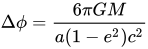 .This can be rewritten using the Einsteinian coupling constant: .This can be rewritten using the Einsteinian coupling constant: ,with the numerical value ,with the numerical value  .The perihelion precession then takes the compact form: .The perihelion precession then takes the compact form: .Here, a .Here, a is the semi-major axis and e is the semi-major axis and e the eccentricity of Mercury’s orbit.In GR the effect is attributed to spacetime curvature. In CIT it is expressed through the universal influx constant κ, derived from the cosmic root-mean-square velocity the eccentricity of Mercury’s orbit.In GR the effect is attributed to spacetime curvature. In CIT it is expressed through the universal influx constant κ, derived from the cosmic root-mean-square velocity  ). Both formulations reproduce the observed value, demonstrating a deep bridge between Einstein’s theory and CIT. ). Both formulations reproduce the observed value, demonstrating a deep bridge between Einstein’s theory and CIT. |
Precession of Mercury as Mass-Energy Growth
The perihelion precession of Mercury, classically explained in General Relativity as a consequence of spacetime curvature, can in Cosmic Influx Theory (CIT) be expressed in terms of the Lorentz transformation of mass energy (LTME).
Starting from the reformulated equation:

we see that the anomalous precession is directly proportional to (γ−1)
In this framework:
- General Relativity (GR): the additional precession is due to the curvature of spacetime in the vicinity of the Sun.
- Cosmic Influx Theory (CIT): the same numerical effect is explained by the increase of mass-energy, expressed by (γ−1)
Thus, Mercury’s perihelion precession can be interpreted as an observational manifestation of influx-driven mass-energy growth. This interpretation complements the κ-based formulation, showing how both constants κ
7.3.4 Alignment Between ACT Observations and CIT Predictions
A striking numerical correspondence exists between the Hubble Parameter derived from the Atacama Cosmology Telescope (ACT) and the value predicted through the theoretical framework of Cosmic Influx Theory (CIT).
In March 2025, researchers from the ACT collaboration released the most precise measurements of the Cosmic Microwave Background (CMB) to date. Their findings confirmed a value of:
> H₀ = 67.8 km/s/Mpc > See: [8.4.32]
This value corresponds exactly to the Hubble constant predicted by CIT, which derives it not from CMB observations, but from a novel theoretical relationship involving:
- The Lorentz Transformation of Mass Energy (LTME),
- The Root Mean Square Velocity (VRMS) of the planets in our solar system (calculated as 12,278 m/s), and
- A geometric scaling involving the surface area factor 4π.
The key identity in CIT is:

Where:
, and

Substituting this velocity into the Lorentz factor yields a small, nonzero value for (γ−1)

This matches the value of Newton’s gravitational constant (G) with astonishing precision.
CIT interprets this result as more than just a coincidence: it suggests that the rate of mass-energy increase per unit surface area per unit mass—governed by the geometry of spherical systems—is fundamentally linked to the same dynamic measured by the Hubble constant.
By dimensional analysis, both G
Therefore, the VRMS-derived equation in CIT leads to a relativistic correction term that behaves like a universal mass-growth constant, and numerically corresponds to the observed expansion rate of space.
While standard ΛCDM cosmology interprets the Hubble constant as a measure of spacetime expansion, CIT offers a complementary interpretation: it reflects the rate of energy influx and associated mass-energy growth throughout the universe. This suggests that two paradigms—one observational, one theoretical—may be measuring the same universal process from different perspectives.
This insight further supports the reinterpretation of Einstein’s Field Equations and the Kappa coupling constant (κ), explored in more depth in [8.1.15] ).
In this view, the Hubble constant becomes not only a measure of cosmic stretching, but also a window into a deeper energy-driven mechanism of continuous mass increase—consistent with the broader claims of Cosmic Influx Theory (CIT).
Numerical Link between VRMS and Hubble Parameter in CIT
Within CIT, the Hubble Parameter is not treated as an isolated measure of cosmic expansion, but as a manifestation of an underlying growth mechanism of mass-energy. By selecting a specific Root Mean Square Velocity (VRMS) of 12,278 m/s, representative of planetary motion, the Lorentz factor γ
This identity connects relativity, mass-energy growth, and gravitational interaction.
Remarkably, this same velocity, when combined with constants like c
H0=2.19720417998897×10⁻¹⁸s−1

This value is the reversed of the Time of the Observable Universe: that is 4.551238383340E+17 seconds or approximately 14.4 billion years.
Ruud Loeffen’s Excel model (see Table 1 in [8.1.15] ) demonstrates over 20 independent equations that result in this same value, including:

and more:


This numerical consistency suggests that the Hubble Parameter is not merely an observational constant, but a derived feature of the universe’s structure—emerging from relativistic geometry, cosmic density, and energy influx. This is a central claim of the Cosmic Influx Theory.
=== 7.3.5. Updated CIT Jeans Mass Concept with Dual Influx Function ===
In classical physics, the Jeans mass defines the critical mass at which a gas cloud becomes unstable and collapses under its own gravity. This threshold is inversely proportional to the square root of the cloud’s density:

In Cosmic Influx Theory (CIT), gravitational attraction is replaced by a universal influx of energy. This influx has a dual function:
- The Influx contributes to the mass-energy growth of the central body in accordance with the Lorentz Transformation of mass energy.
- The Influx drags matter inward, acting as a vector field that directs gas and dust toward the center.
Collapse in CIT occurs when internal thermal pressure is no longer sufficient to resist the combined effect of influx pressure and its inward dragging action. This leads to a CIT variant of the Jeans mass, denoted as MCIT
This leads to a CIT variant of the Jeans mass:

Where:
= gas temperature
= gas density
= influx pressure density (energy per unit area per unit time)
= influx dragging efficiency (momentum transport toward the center per unit volume)
This formulation preserves the inverse square root relation with density, while replacing the gravitational constant 
== 7.4 Conclusion == This chapter has provided a structured overview of:
- The unit conversions required in CIT.
- The five-dimensional framework, incorporating expansion.
- The derivation of fundamental constants, particularly G and κ_CIT.
Numerical box (CIT exact Ho): ACT–CIT alignment
Assume:
- c = 299,792,458 m/s
- 1 Mpc = 3.085677581×10^22 m
- Ho(CIT) = 6.7798636801511×10^4 m s⁻¹ Mpc⁻¹ = 67.798636801511 km s⁻¹ Mpc⁻¹
Conversions:
- Ho = (6.7798636801511×10^4) / (3.085677581×10^22) = 2.19720418033886×10⁻18 s⁻¹
- Tu = 1/Ho = 4.55123838261484×10^17 s
- Ru = c/Ho = 1.36442694166805×10^26 m
- 1 Mpc / c = (3.085677581×10^22) / 299,792,458 = 1.029271250×10^14 s
7.5 Overview of Important Constants Related to Cosmic Influx Theory (CIT)
The following table summarizes the fundamental constants used in Cosmic Influx Theory (CIT), along with their derived relationships:
| Constant Name | Symbol | Units | Expression in CIT | Value |
|---|---|---|---|---|
| Hubble Parameter | H₀ | 1/s | 67,798.637 m/s per Mpc | 2.1972 × 10⁻¹⁸ |
| Gravitational Constant | G | m³/(kg·s²) | VRMS² / (8πc²) | 6.674 × 10⁻¹¹ |
| Einsteinian Coupling Constant | κ | m/kg | (8πG) / c² | 1.866 × 10⁻²⁶ |
| Einsteinian Coupling Constant (Alternative Expression) | κ | m/kg | 8H₀ / (πc) | 1.866 × 10⁻²⁶ |
| Einsteinian Coupling Constant (Alternative Expression) | κ | m/kg | VRMS² / c⁴ | 1.866 × 10⁻²⁶ |
| Kappa-CIT | κ_CIT | m/kg | G / VRMS² | 4.4271 × 10⁻¹⁹ |
| Kappa-CIT (Alternative Expression) | κ_CIT | m/kg | (κ × c²) / (8π VRMS²) | 4.4271 × 10⁻¹⁹ |
| Kappa-CIT (Alternative Expression) | κ_CIT | m/kg | 1 / (8π c²) | 4.4271 × 10⁻¹⁹ |
| Kappa-CIT (Alternative Expression) | κ_CIT | m/kg | D_pref / M_star | 4.4271 × 10⁻¹⁹ |
| Preferred Distance | D_pref | m | (ε₀ × M_star) / (2 × 10⁷) | Depends on the star |
| Preferred Distance (Alternative Expression) | D_pref | m | M_star / (8π c²) | Depends on the star |
| Preferred Distance (Alternative Expression) | D_pref | m | G × M_star / VRMS² | Depends on the star |
| Vacuum Permittivity | ε₀ | kg/m | (1 / (8π c²)) × (2 × 10⁷) | 8.541 × 10⁻¹² |
| Vacuum Permittivity (Alternative Expression) | ε₀ | kg/m | (G / VRMS²) × (2 × 10⁷) | 8.541 × 10⁻¹² |
| Vacuum Permeability | μ₀ | H/m | 4π × 10⁻⁷ | 1.256 × 10⁻⁶ |
| Influx at Planck Mass | PlInflux | m³/s² | 4π × lₚ³ / tₚ² | 1.82538 × 10⁻¹⁷ |
This table provides a structured overview of how fundamental constants are interconnected within Cosmic Influx Theory.
Clarifying κ vs. κCIT: Unified by vRMS
Within CIT, two constants are derived from the same foundational velocity: the root mean square velocity vRMS, interpreted as a residual motion of the original protoplanetary disk — and possibly of the universe itself.
- The first is the dynamic influx constant:
κ = vRMS2 / c4 ≈ 1.8663 × 10⁻²⁶ m/kg
This constant appears in acceleration equations and expresses the subtle energetic influx present throughout the universe.
- The second is the structural scaling constant:
κCIT = G / vRMS2 = 1 / (8πc2) ≈ 4.4271 × 10⁻¹⁹ m/kg
It defines the proportionality between stellar mass and preferred distance for giant planet formation, and shows up in planetary structuring equations like:Dpref = κCIT × Mstar
These two constants are distinct in application but unified in origin, both emerging from the fundamental residual velocity vRMS. Together, they reflect how a single, observable velocity scale may underlie both cosmic structure and expansion — offering a physically grounded alternative to dark energy or geometric rotation.
These principles solidify CIT’s framework, linking gravitational dynamics to energy influx and planetary structuring. The next step involves integrating these derivations with observational data from exoplanet studies and planetary surface expansion measurements.
Notation
- VRMS = 1.227824570057950×10^4 m/s (calibrated RMS velocity used in CIT). Throughout this page only VRMS is used.
Core identities (CIT, SI-consistent)


Summary
Chapter 7 provides a foundational framework for the units, dimensions, and constants used in Cosmic Influx Theory (CIT). It begins with unit conversions essential for calculations in CIT, ensuring consistency with standard physics measurements.
The chapter then introduces CIT’s five-dimensional framework, which extends beyond traditional 3D space and time by incorporating expansion (e) as a fundamental dimension. This expansion is key to understanding planetary growth and cosmic structuring.
Next, the chapter explores the derivation of key constants in CIT, particularly:
- The Universal Scaling Constant (κCIT), which defines planetary structuring and preferred distances.
- The Einsteinian Coupling Constant (κ), which links gravitational interactions to cosmic expansion.
By redefining these constants within CIT’s framework, the chapter offers a new perspective on gravitational dynamics and planetary formation.
++ Navigation